Almost everyone has heard of THC and CBD by now. But did you know that cannabis contains over 100 different cannabinoids and more than 200 terpenes? And that your body has its own system that acts like a lock waiting for these keys? Welcome to the endocannabinoid system — the foundation of why cannabis has any effect at all.
The Endocannabinoid System: Your Body’s Own Cannabis Network
Before we talk about cannabinoids, we need to understand the system they dock onto. The Endocannabinoid System (ECS) was only discovered in 1992 — yet it is one of the oldest and most important regulatory systems in the human body.
The ECS consists of three components:
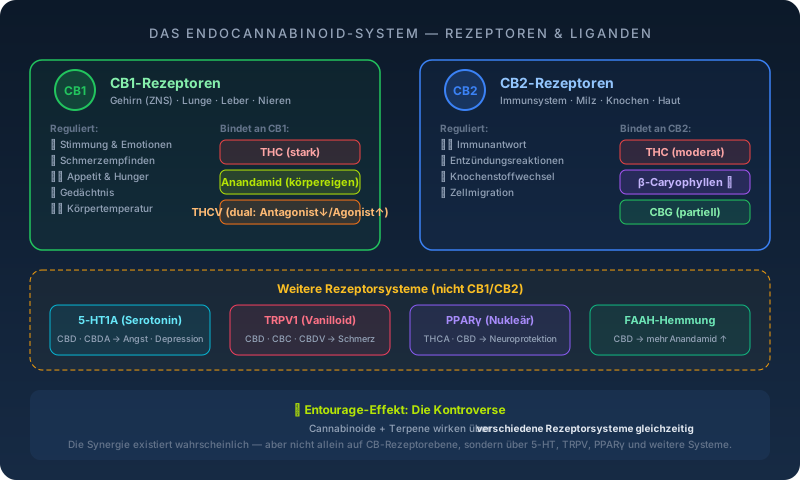
- CB1 receptors — the most abundant receptors in the brain. They regulate pain perception, appetite, mood, and memory.
- CB2 receptors — primarily in the immune system. They control inflammatory responses.
- Endocannabinoids — the body’s own molecules (anandamide and 2-AG) that bind to these receptors.
Think of CB1 receptors as traffic officers in the brain: They control the flow of neurotransmitters and maintain balance. Cannabis works because phytocannabinoids from the plant mimic these endogenous endocannabinoids — they “hijack” the system. (PMC Review)
CBGA: The Mother of All Cannabinoids
All cannabinoids begin as one molecule: cannabigerolic acid (CBGA). This precursor is converted by specific enzymes into the acidic forms THCA, CBDA, and CBCA. Only through decarboxylation — the removal of a CO₂ molecule through heat — do the well-known active forms THC, CBD, and CBC emerge. (PMC: Cannabinoid Biosynthesis)
This means: The raw plant contains almost no THC. Only when cannabis is heated — by smoking, vaporizing, or baking — does THCA become the psychoactive THC. A fascinating detail: the acidic precursors like THCA and CBDA themselves have biological effects. THCA, for example, acts as a PPARy agonist with neuroprotective properties.
The Big Five: Major Cannabinoids at a Glance
| Cannabinoid | Psychoactive? | Key Properties | Research Status |
|---|---|---|---|
| THC | Yes | Pain-relieving, appetite-stimulating, euphoric | Well-studied |
| CBD | No | Anti-inflammatory, anxiolytic, antispasmodic | Well-studied |
| CBG | No | Antibacterial, appetite-stimulating, neuroprotective | Promising |
| CBN | Mildly | Sedating, emerges from THC degradation | Limited |
| THCV | At high doses | Appetite-suppressing, energizing | Early stage |
THC (Delta-9-Tetrahydrocannabinol)
THC is the most well-known cannabinoid and the primary psychoactive component in cannabis. It binds mainly to CB1 receptors in the brain, which explains its effects on perception, mood, and pain sensation. In medicine, THC is used for chronic pain, nausea during chemotherapy, and appetite loss. The flip side: at high doses or in susceptible individuals, THC can trigger anxiety, paranoia, and short-term memory impairment.
CBD (Cannabidiol)
CBD is the second most abundant cannabinoid and does not cause intoxication. Unlike THC, it does not bind directly to CB1 receptors but modulates the ECS indirectly — among other things by inhibiting the FAAH enzyme, which breaks down the body’s own endocannabinoid anandamide. The result: more anandamide in the system, which has a calming effect. CBD is also used medically, including as Epidiolex for severe forms of epilepsy.
CBG (Cannabigerol)
CBG is the “stem cell” among cannabinoids — the non-acidic form of CBGA. It is only present in small amounts in mature plants because most CBGA has already been converted into THCA or CBDA. A comprehensive review (2025) highlights CBG’s potential: antibacterial properties (including against MRSA), neuroprotective effects, and anti-inflammatory activity.
CBN (Cannabinol)
CBN is not produced by the plant directly — it results from the oxidation of THC. When cannabis ages or is stored exposed to light and air, THC slowly converts to CBN. CBN has only mildly psychoactive properties and is often associated with a sedating effect, though the scientific evidence for this is limited.
THCV (Tetrahydrocannabivarin)
THCV is structurally similar to THC but has different effects: at low doses it acts as a CB1 antagonist (blocks THC effects), while at high doses it becomes a CB1 agonist with its own psychoactive effect. THCV is particularly interesting for research due to its potentially appetite-suppressing properties — the opposite of THC’s classic “munchies.”
Top 5 Terpenes: The Scent Molecules with Effects
Terpenes are not unique to cannabis — they are among the most common compounds in nature. What makes them special in cannabis: they interact with the endocannabinoid system and may modulate cannabinoid effects. (PMC: Terpenes in Cannabis — Are They Important?)

Myrcene — The Relaxer
Myrcene is the most common terpene in cannabis and responsible for the typical earthy, musky aroma. It is also found in hops, mango, and thyme. Myrcene is associated with relaxing, sedating properties and is the terpene that most strongly correlates with “Indica” labeling (see our previous article).
Limonene — The Mood Booster
Limonene gives citrus fruits their characteristic scent and is one of the most well-studied terpenes. It is associated with mood-elevating, stress-reducing properties. Limonene is also used in aromatherapy and may enhance the bioavailability of other substances through the skin and mucous membranes.
Linalool — The Calmer
Linalool is the main terpene in lavender and is responsible for the floral, calming scent that has been used for centuries. In cannabis, linalool is associated with anxiolytic and sedating properties. A study in Frontiers in Neuroscience highlights the potential of linalool and pinene for brain health.
Alpha-Pinene — The Clarifier
Pinene is the most widespread terpene in nature — it gives pine forests their distinctive scent. In cannabis, alpha-pinene is associated with focus-enhancing and anti-inflammatory properties. Interestingly, pinene may counteract some of THC’s memory-impairing effects.
Beta-Caryophyllene — The Special One
Caryophyllene is unique among terpenes: it is the only terpene known to directly bind to CB2 receptors — making it technically both a terpene and a cannabinoid. It is found in black pepper, cloves, and cinnamon and has anti-inflammatory properties. This dual nature makes beta-caryophyllene a focus of current research.
The Entourage Effect: Synergy or Myth?
The entourage effect is one of the most discussed concepts in cannabis science. The idea: cannabinoids and terpenes work together and produce a different (stronger or more nuanced) effect than isolated individual substances.
Evidence For
- A comprehensive review (2025) confirms that full-spectrum extracts in clinical studies often work differently than isolated THC or CBD.
- Patients regularly report that whole-plant products have different effects than pure isolates.
- A study on mood and anxiety showed that certain terpene-cannabinoid combinations have specific effects on emotional well-being.
Evidence Against
- A study from 2020 found no direct interaction between terpenes and CB receptors at physiologically relevant concentrations.
- Critical voices (2023) point out that many entourage studies are not well-controlled and the effect may be smaller than assumed.
The Verdict
The truth likely lies in the middle: The entourage effect exists, but it’s more subtle than often marketed. The interaction between cannabinoids and terpenes is real but works through complex, not yet fully understood mechanisms — not through simple “this terpene amplifies that cannabinoid” equations. For practical use, this means: Full-spectrum products tend to work differently than isolates, and the terpene profile contributes to the overall experience.
Practical Tips: What This Means for You
- Don’t just look at THC content — A strain with 18% THC and a rich terpene profile can have a more complex experience than a 25% THC strain with few terpenes.
- Trust your nose — Terpenes are volatile and perceivable through smell. A strain that smells appealing to you often indicates a terpene profile that suits you.
- Temperature matters — Different cannabinoids and terpenes vaporize at different temperatures. Lower temperatures (around 170°C) release more terpenes; higher temperatures (around 210°C) release more THC.
- Keep a journal — Document which strains have which effects on you. Over time, you’ll see patterns in terpene profiles and your individual response.
- Start low, go slow — Especially with new strains or products: start with a low dose and wait for the effect before increasing.
Safer Use: Cannabis affects everyone differently. Start with low doses and pay attention to your body’s signals. When consuming for the first time or after a long break, be especially cautious. In case of anxiety or panic, remember: the effect is temporary. For questions, the Sucht & Drogen Hotline (01806 — 313 031) is available free of charge and anonymously.
Open Research Questions
Despite enormous progress, cannabis science still has many open questions:
- Minor cannabinoids: Over 100 cannabinoids are known, but only a handful have been studied in detail. What do CBT, CBDV, or Delta-8-THC do exactly?
- Individual differences: Why does the same strain affect two people completely differently? Genetics, the microbiome, and hormone levels likely play a role — but research is still in its early stages.
- Long-term effects: Most studies examine short-term effects. Long-term studies on different consumption forms and cannabinoid profiles are largely lacking.
- Standardization: There is no uniform standard for lab analysis of terpene profiles. This makes it difficult to compare results across different labs and products.
Sources
- Lu, H.-C. & Mackie, K. (2021): Review of the Endocannabinoid System. Biological Psychiatry.
- Luo, X. et al. (2021): Complete Biosynthesis of Cannabinoids and Their Unnatural Analogues in Yeast. Nature.
- Formato, M. et al. (2020): Terpenes in Cannabis sativa — From Plant Genome to Humans. Molecules.
- Santiago, M. et al. (2019): Absence of Entourage: Terpenoids Commonly Found in Cannabis Do Not Modulate the Functional Activity of CB Receptors. Nature Scientific Reports.
- Christensen, C. et al. (2023): Decoding the Entourage Effect. Expert Review of Clinical Pharmacology.
- Zagzoog, A. et al. (2025): Comprehensive Review of the Entourage Effect. Pharmacological Reviews.
- Ferber, S. G. et al. (2020): The Entourage Effect: Terpenes Coupled with Cannabinoids for Mood and Anxiety. Current Neuropharmacology.
- Nadal, X. et al. (2017): THCA as PPARy Agonist — Neuroprotection in Huntington’s Disease. Neurotherapeutics.
- Nachnani, R. et al. (2025): Comprehensive Review of CBG. Cannabis and Cannabinoid Research.
- Calapai, F. et al. (2022): Pharmacological Aspects of CBG. Pharmacology.
- Weston-Green, K. et al. (2021): Pinene and Linalool for Brain Health. Frontiers in Neuroscience.
- BZgA: Cannabisprävention — Information on risks and prevention.
Disclaimer: This information is for educational purposes only and does not constitute medical advice. Consult a physician for health-related questions. Cannabis use carries risks, especially for young people and individuals with predispositions to mental health conditions.